.png)


Key Takeaways
- Detached ADUs typically offer superior privacy for multigenerational families compared to home additions
- In Palo Alto, detached ADUs can be up to 1,200 sq ft, and you can combine a Junior ADU (JADU) with a detached ADU on the same lot
- Single-story ADU floor plans with wide doorways and zero-threshold showers are the gold standard for aging in place
- Acton ADU manages the full process - from permits and city inspections to final construction - under one roof
- The first step is a property feasibility study to confirm what's possible on your specific lot
Evaluating Housing Solutions for Multigenerational Families
Silicon Valley has always attracted families who plant deep roots, and Palo Alto is no exception. Over the past decade, multigenerational living has surged across the Bay Area as families navigate the twin pressures of sky-high housing costs and the desire to care for aging parents without sacrificing anyone's independence. For Palo Alto homeowners, the question is rarely whether to create space for extended family - it's how to do it in a way that works for everyone under one roof, or at least on one lot.
The options generally fall into three categories: retrofitting rooms within the existing main house, building an attached addition, or constructing a separate Accessory Dwelling Unit (ADU) on the property. Each has merits, but the right choice depends heavily on your lot size, family dynamics, and long-term goals. Palo Alto's residential lots in neighborhoods like Crescent Park or Old Palo Alto are often generous enough to accommodate a detached backyard cottage, while smaller lots in areas like Ventura may steer families toward attached or interior conversion solutions.
Creating private living spaces for aging parents within a single-family Palo Alto lot is not just possible - it has become a well-traveled path. The city's alignment with California state ADU law means homeowners have more flexibility than ever to add a fully independent unit with its own entrance, kitchen, and bathroom. This setup strikes the ideal balance between proximity for caregiving and genuine autonomy for the people living there. Grandparents can be close enough to share Sunday dinners but far enough to maintain their own routines and dignity.
The most successful multigenerational arrangements share one common thread: thoughtful design that respects everyone's need for personal space. That begins with choosing the right structural approach for your property.
Privacy by Design: Detached ADUs vs. Home Additions
When families compare a backyard cottage to a home addition, privacy almost always tips the scales toward detached construction. An attached addition, while sometimes more cost-effective upfront, shares walls, HVAC systems, and often entryways with the main house. Sound travels. Daily schedules collide. What feels like a generous guest suite during construction can feel uncomfortably intimate once real life begins.
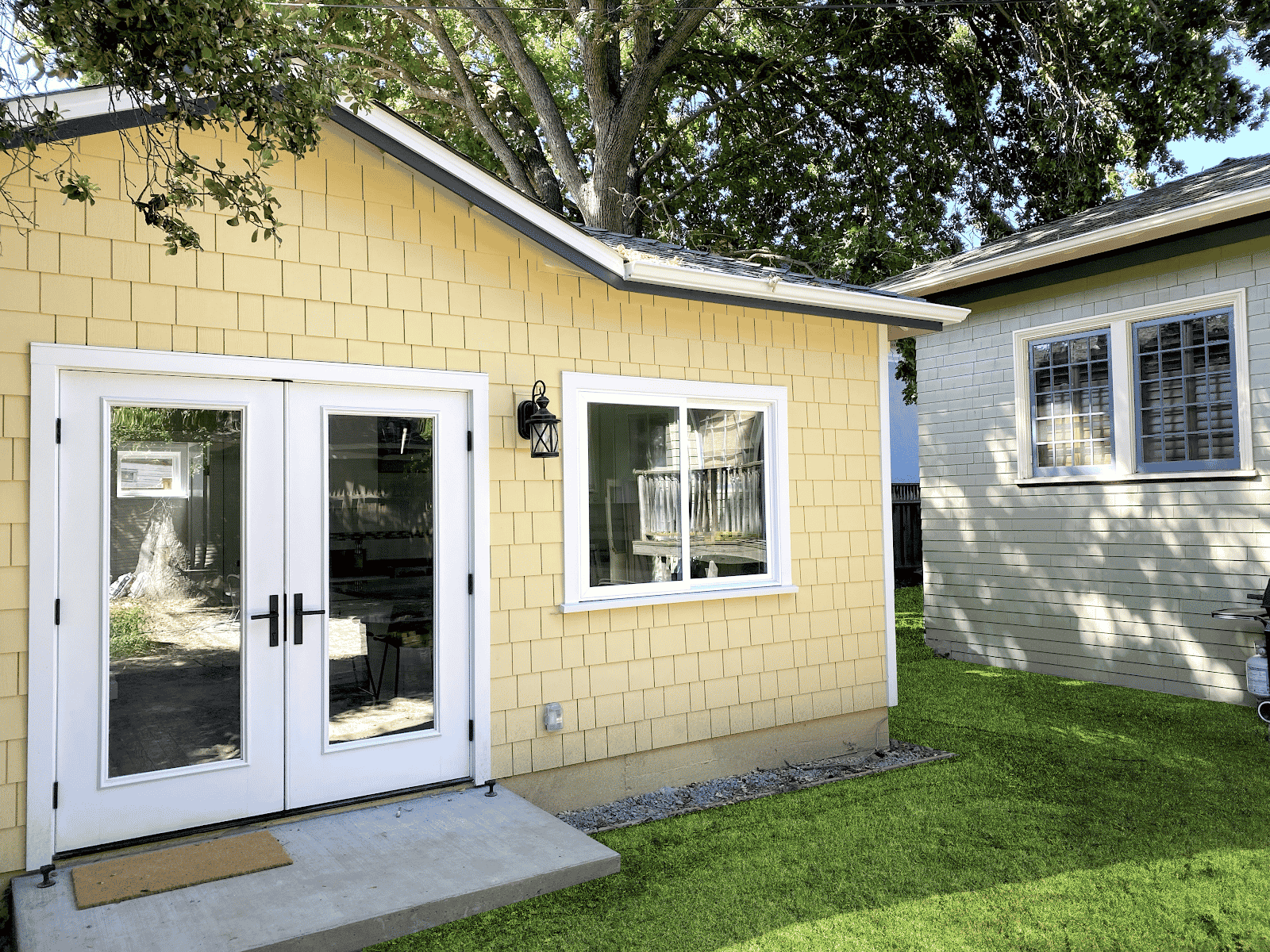
A detached ADU - a freestanding backyard cottage set apart from the primary residence - solves these problems by design. The physical separation creates a natural acoustic buffer. Without shared walls, everyday noise from the main house (children, televisions, early morning routines) stays where it belongs. For aging parents who may have different sleep schedules or need quieter environments for health reasons, this separation is not a luxury - it is a genuine quality-of-life consideration.
Visual separation matters just as much as acoustic privacy. A well-designed detached ADU can be positioned and oriented so that the main house and the cottage each have distinct outdoor areas, separate sightlines, and independent entryways. Strategic landscaping - mature hedges, pergolas, or simple fencing - can further define each household's territory without creating a fortress-like feel. The goal is two households sharing a property, not one household awkwardly divided.
There is also a psychological dimension that often goes unacknowledged. Having your own front door - a threshold that is unambiguously yours - has a meaningful impact on a person's sense of independence and dignity. This matters enormously for aging parents who may already be navigating the emotional complexity of relying more on family. A separate entrance says, quietly but clearly, that they are guests of their own lives, not tenants of their children's.
From a cost perspective, new detached construction allows you to incorporate soundproofing, insulation, and accessibility features from the ground up - which is almost always more efficient and less expensive than retrofitting an existing structure. When you compare the long-term value and livability of a purpose-built backyard cottage against a remodeled addition, the detached ADU consistently delivers a better return on both investment and daily life. For a closer look at completed projects, Acton ADU's portfolio offers examples of how these structures are adapted to real Bay Area lots.
Maximizing Your Lot: Palo Alto Zoning and Regulations
Understanding what Palo Alto's regulations allow is the foundation of any realistic planning conversation. Under current California state law - which Palo Alto must comply with - detached ADUs can be built up to 1,200 square feet, regardless of lot size. This applies to new construction on single-family lots and represents a significant shift from older, more restrictive local standards. The 2026 regulatory landscape continues to favor ADU development, with ongoing state pressure on municipalities to streamline approvals and reduce barriers for multigenerational and workforce housing.
One of the most powerful tools available to Palo Alto homeowners is the ability to combine housing types on a single lot. An Accessory Dwelling Unit (ADU) is a fully independent dwelling with its own kitchen, bathroom, and entrance, typically built as a detached structure or over a garage. A Junior ADU (JADU), by contrast, is a smaller unit of up to 500 square feet created by converting existing interior space within the main house - often a bedroom or attached garage. California law explicitly permits homeowners to build both a JADU and a full detached ADU on the same single-family property, effectively creating three distinct living spaces on one lot. For families with both aging parents and adult children who need housing, this combination offers remarkable flexibility.
Here is a quick reference for Palo Alto ADU planning:
Setback rules in Palo Alto require detached ADUs to sit at least 4 feet from rear and side property lines in most cases, though corner lots and specific zoning designations can affect this. ADUs are also generally exempt from Floor Area Ratio (FAR) calculations that would otherwise limit how much square footage can be added to a property - a significant advantage that makes it possible to add meaningful living space without running into lot coverage conflicts. For the most current details on Palo Alto ADU regulations, consulting directly with a local ADU specialist who tracks ongoing code changes is essential before committing to any design.
Strategic unit placement can help you maximize both square footage and quality of life. Positioning the ADU near the rear of the lot, oriented to face a garden rather than the main house, creates natural separation and allows both households to enjoy outdoor space without visual overlap.
Designing for the Future: Accessibility and Aging in Place
Building for a parent who is healthy and active today means designing for the person they may become in five or ten years. Aging-in-place design is not about creating a medical facility - it is about building a home that remains comfortable and safe across a wide range of mobility and health scenarios, without ever looking institutional.
Single-story floor plans are the most important foundational choice for aging-in-place ADUs
Eliminating stairs removes the single greatest injury risk for older adults and ensures the unit remains fully accessible even if mobility changes significantly over time. Within that single-story layout, the key features are doorways of at least 36 inches wide (to accommodate walkers or wheelchairs), open-plan living areas that allow for easy navigation, and a bathroom designed around a zero-threshold (curbless) shower with blocking in the walls for future grab bar installation.

Kitchen and bathroom design deserve particular attention
Counter heights can be varied to accommodate both seated and standing users. Lever-style door handles and pull-out drawers replace knobs and deep cabinets. In bathrooms, a comfort-height toilet, handheld showerhead, and non-slip flooring make daily routines safer without sacrificing aesthetics. These modifications are most cost-effective when built into original construction - retrofitting them later is both expensive and disruptive.
Lighting and flooring choices are often underestimated
Older adults need significantly more light than younger people to navigate safely, so designing for ample natural light - through well-placed windows and skylights - combined with layered artificial lighting reduces fall risk substantially. Flooring should be continuous, low-contrast, and slip-resistant throughout. Avoiding raised transitions between rooms and choosing matte finishes over high-gloss surfaces are small decisions that have outsized safety impacts. Acton ADU works with families to customize these details for specific needs, ensuring each unit is built around the people who will actually live in it.
From Feasibility to Finish: The Acton ADU Process
For most homeowners, the greatest barrier to getting started is not motivation - it is the complexity of permits, city inspections, utility coordination, and contractor management. This is where working with a full-service, design-build firm like Acton ADU makes a decisive difference. Rather than hiring a designer, then a structural engineer, then a general contractor, and managing communication between all of them, Acton ADU handles every phase of the project under a single point of accountability.
Acton ADU manages the entire permitting and city inspection process on behalf of homeowners. This includes preparing and submitting architectural and structural drawings, Title 24 energy compliance documentation, utility applications, and all required city submittals to Palo Alto's planning and building departments. Given that Palo Alto's planning process has its own specific requirements and review timelines, having a team that has navigated this process repeatedly - and knows where delays typically occur - is a concrete advantage that translates directly into a smoother, faster project.
The process follows three clearly defined phases:
- Feasibility - Acton ADU reviews your property's zoning, lot size, setbacks, and existing structures to confirm what is buildable and present clear options tailored to your goals.
- Pre-Construction - Design is finalized, permits are acquired, and all engineering and compliance work is completed before a single nail is driven.
- Build and Warranty - Construction is managed by Acton ADU's experienced crews, with ongoing updates via an online project portal and a warranty covering the completed unit.
The feasibility study is the critical first step - and the one most families wish they had done sooner. It eliminates guesswork, surfaces any site-specific constraints early, and gives you a realistic picture of cost and timeline before any commitment is made. For a multigenerational project where family plans, budgets, and caregiving timelines are often intertwined, this clarity is invaluable.
Ready to explore the possibilities for your property? Schedule a free feasibility consultation with Acton ADU today to design a home that brings your family together - on your terms, and built to last for generations.